If you’ve ever wandered a patio draped in warm, twinkling lights or a market stall strung with festoon bulbs, you’ve probably asked yourself a quiet question: are those bright, energy-efficient LED festoon bulbs really brighter than the old incandescent ones they replaced? As a festoon bulb supplier who’s spent the last 12 years talking to customers, from café owners putting up outdoor string lights for patio dining to homeowners sprucing up backyard wedding venues, I hear this question all the time. It’s not a trivial one, either—brightness is make-or-break for how lights set a mood, and no one wants to waste money on bulbs that don’t deliver. Let’s break this down beyond the marketing buzzwords, and pull back the curtain on what actually makes festoon bulbs shine (or not shine). Festoon Bulb
First, let’s get one basic term out of the way that trips up almost everyone: lumen. That’s the official measure of visible light a bulb produces—way more reliable than the old “watt” number we used for incandescents. For decades, we judged bulb brightness by watts because incandescents were inefficient: 90% of their energy turned to heat, only 10% to light. A 25-watt incandescent, for example, gave roughly 220 lumens, and that was the only reference we had. But LEDs don’t work that way. A 2-watt LED can produce the same 220 lumens, because almost all its energy goes to light, not heat. That’s where the myth starts: many people still compare wattages instead of lumens, so they assume a 5-watt LED is way brighter than a 25-watt incandescent, which isn’t true if their lumen counts match.
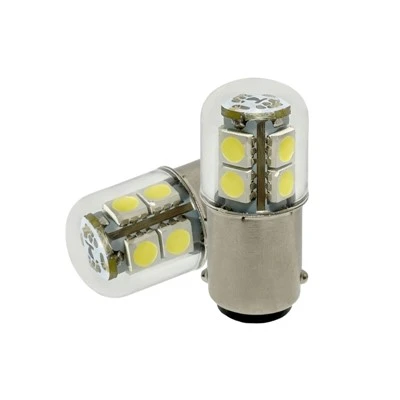
Now, let’s get specific to festoon bulbs, because they’re not like standard A-line bulbs or LED downlights. Festoon bulbs are those slim, often 5-watt (for standard string lights) or 10-watt (for heavy-duty commercial use) bulbs with a double-ended base, made to slot into the metal sockets of festoon string lighting. Incandescent festoon bulbs are typically marked by their old wattage, while LED festoon bulbs are marked by lumens. Let’s take the two most common sizes we stock for residential and commercial use: the S14 (1.4 inches wide, 2.75 inches long) bulb, the workhorse of most outdoor string lights.
A standard incandescent S14 puts out about 150 lumens, uses 7 watts, and runs hot enough that you can’t touch it for more than a second after it’s been on. Our basic LED S14 festoon bulb puts out 150 lumens too, but uses only 1.5 watts. If you go up to a higher-lumen LED S14, like the ones we make for larger spaces that need more glow, you’ll see 250 lumens from a 2.5-watt LED—so that’s brighter than a 150-lumen incandescent, for a fraction of the energy. But here’s the catch that most suppliers won’t tell you: not all LEDs are created equal. A cheap LED from a no-name brand might cut corners on the lumen output to save money, so a “2-watt LED” could only put out 120 lumens, which is dimmer than that 7-watt incandescent. That’s why as a supplier, we test every batch of our LED festoon bulbs with a spectrophotometer to confirm lumen output—no guesswork, no false labeling.
Next, there’s color temperature, which plays a huge role in how bright a bulb looks to the human eye. Two bulbs can have the same lumen count, but one might feel much brighter because its light hits the eye more naturally. Incandescent bulbs have a warm color temperature, around 2700K, which is that soft, golden glow we all associate with old party lights. LED festoon bulbs come in warm white (2700K, matching incandescents), soft white (3000K), and even cool white (5000K+). Our customers often tell us their LED festoon bulbs look “dimmer” than incandescents at first, until they check the color temperature: if you’re comparing a 2700K LED to a 2700K incandescent, the brightness feels almost identical, because the color is the same. But if you accidentally pick a 5000K cool white LED, that light is bluer, and our eyes perceive blue light as brighter than golden light—so a 200-lumen cool white LED will look brighter than a 200-lumen warm white incandescent, even though the actual lumen count is the same. That’s a huge tip for anyone shopping for festoon lights: stop looking at wattage, check lumens and color temperature.
Heat is another underdiscussed factor that affects perceived brightness, especially for outdoor festoon bulbs. Incandescent festoon bulbs run so hot—up to 250 degrees Fahrenheit—that the glass can get too hot to touch, and that heat actually warps the light as it spreads, making it feel diffused instead of sharp. LED festoon bulbs run at a fraction of that heat, usually under 100 degrees Fahrenheit even after 12 hours of use, so the light is crisp and doesn’t get softened by heat. For a patio, that means the light stays bright and even across the entire string, instead of dimming near the ends where the heat might cause old incandescents to flicker or fade. We’ve had a café in Portland tell us that since switching from incandescent to our LED festoon bulbs, their patio feels brighter at night, and customers say they can read menus outside without squinting—even though their energy bill went down 75% because LEDs use way less power.
But let’s not leave out the cases where incandescents might feel brighter, at least at first. If you’re used to the nostalgic, golden glow of incandescents, a 150-lumen LED that matches that color temperature will feel familiar, but if you’re upgrading a old string light setup that had 200-lumen incandescents, you’ll need a higher-lumen LED to get the same or brighter effect. Here’s a quick cheat sheet from our years of data: for every 1 watt of incandescent festoon, you need roughly 0.25 watts of LED to get the same lumen output. So a 10-watt incandescent festoon (common for commercial string lights) will give about 200 lumens, so a 2.5-watt LED will match that brightness; a 15-watt incandescent would need a 3.75-watt LED. That’s why we stock LED festoon bulbs in 1.5W, 2.5W, and 5W options—so customers can pick exactly what they need, not settle for a one-size-fits-all.
Another point that’s crucial for festoon bulbs specifically: longevity. If a bulb burns out after a week, it doesn’t matter if it’s bright—you’re replacing it constantly, which dims the overall string of lights as you swap out dead bulbs. Incandescent festoon bulbs last about 1,000 hours on average, while our LED festoon bulbs last 25,000 to 30,000 hours. That means over the life of the string, you’re getting way more consistent brightness, because there are fewer dead bulbs. We’ve had a wedding planner tell us that at outdoor weddings, they used to have to carry 20 extra incandescent bulbs, because half would burn out during a 4-hour event. Now with our LEDs, they barely need one spare—so the string stays bright the entire time, no mid-reception black spots.
Now, let’s address the common misconception that all LEDs are brighter than incandescents. That’s not true, especially when you’re comparing cheap, untested LEDs from big-box stores. I’ve seen customers come to us after buying a pack of off-brand LED festoon bulbs at a discount store, only to tell us their lights are way dimmer than the old incandescents they replaced. Why? Those cheap LEDs use low-quality diodes that output far fewer lumens than advertised, and they often have a color temperature that’s too cool, making the light feel harsh instead of warm. As a supplier, we only work with diode manufacturers that test every batch to ensure lumen output matches the label, and we send sample batches to customers before they place a bulk order—so they don’t end up with dud bulbs that ruin their event or business.
We also test for outdoor durability, which affects perceived brightness too. Festoon bulbs are almost always used outside, so they have to handle rain, wind, and temperature swings. Incandescent bulbs can shatter if they get hit by a gust of wind, and the filament inside can break from vibration, which makes them dim or stop working. Our LED festoon bulbs have shatter-resistant polycarbonate glass instead of fragile glass, so even if a bulb gets knocked, it keeps working, keeping the string bright. We also make them with IP65 waterproof ratings, so they can stand up to heavy rain without losing brightness or burning out.
Let’s wrap this up with a real example from a customer I worked with last spring. A small restaurant in Austin was planning a patio expansion, and they were choosing between incandescent and LED festoon bulbs. They initially went with incandescents because they thought they were brighter, but after a side-by-side test of our LED S14 bulbs, they noticed two things: first, the 2.5-watt LED bulbs put out 250 lumens, which was brighter than the 7-watt incandescent’s 150 lumens, and second, the light from the LEDs was consistent across the entire string, while the incandescents had dim spots near the end of the 50-foot string. They switched to our LEDs, and a month later, they told us their patio sales were up 15%—customers said they felt more comfortable dining outside at night, because the light was bright enough to see, but warm enough to feel cozy.
So to answer the question: are LED festoon bulbs brighter than incandescent? It depends, but when you pick high-quality, correctly labeled LEDs with matching color temperature and appropriate lumen output, yes, they can be brighter, while using way less energy and lasting far longer. The key is to stop relying on old wattage comparisons, and instead look at lumens and color temperature—factors we prioritize in every LED festoon bulb we make.
If you’re a café owner, wedding planner, or homeowner looking to upgrade your festoon lights, and you want to test the difference for yourself, we offer sample packs so you can compare our LEDs to the incandescents you’re currently using. Reach out to our team to discuss your project needs, whether that’s a small residential string for your backyard or bulk commercial bulbs for a large outdoor venue. We’re here to help you find the right brightness, durability, and value for your space.
G4 Bulb References
- U.S. Department of Energy. (2023). Lighting Facts: How to Choose Light Bulbs. Retrieved from energy.gov
- Illuminating Engineering Society (IES). (2022). IES Lighting Handbook: Color Temperature and Perceived Brightness.
- National Electrical Manufacturers Association (NEMA). (2021). LED Bulb Performance Standards for Outdoor Lighting.
- Festoon Lighting Manufacturers Association. (2023). Durability Testing for Outdoor Festoon Bulbs.
Nicebulbs
As one of the most professional festoon bulb manufacturers and suppliers in China, our products have good reputation in the market. Please feel free to wholesale cheap festoon bulb for sale here and get pricelist from our factory. Quality products and reasonable price are available.
Address: No. 86 Zhongli Road, Nancheng Street, Dongguan City, Guangdong Province
E-mail: vic@nicebulb.com
WebSite: https://www.nicebulbs.com/
