Hey there, ever found yourself staring at a high-end gaming PC or a compact workstation and wondered why some builds run way quieter and cooler than others, even when cranking out maximum performance? If you’ve glanced at specs for liquid cooling gear, you’ve probably seen “low profile” tossed around a lot—like it’s just a marketing buzzword, right? But as someone who’s spent the last decade designing and supplying liquid cooling components for all kinds of builds, let me break down what a low profile liquid cooling kit actually is, why it matters, and how it’s not just a fancy gimmick. Liquid Cooling Components
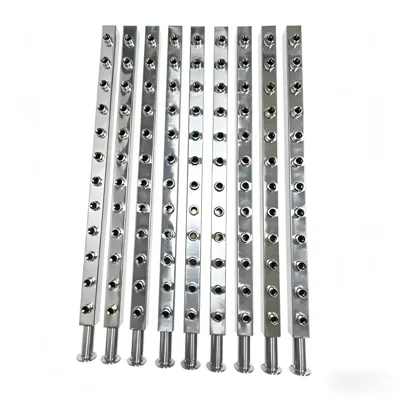
First, let’s cut the jargon. A standard full-size liquid cooling kit is built for big desktops with plenty of space: you’ve got a 240mm radiator that sticks out a few inches from the case, a pump that’s bulkier, and tubes that run loose and long. A low profile kit? It’s made to fit tight spaces—think small form factor (SFF) PCs, compact workstations, even some gaming laptops with modified cooling setups. The key here is height, and that’s where most people get tripped up. A typical full-size AIO (all-in-one, for the uninitiated—pre-sealed liquid cooling kits, no messy tubing to assemble) might have a radiator that’s 27mm thick, but a low profile one shaves that down to 15mm or even 12mm. The pump block is shorter too, so it doesn’t crowd RAM sticks or the top of your motherboard’s CPU socket.
Wait, hold up—you might be thinking, “Why does that matter?” A lot of modern PC builders are ditching those massive tower cases that take up half a desk. SFF builds are popular because they’re portable, look clean on a small desk, and don’t generate as much excess heat in small rooms. But SFF cases have almost no vertical or internal space. If you try to stuff a regular full-size AIO into an SFF case, you’ll either have to bend your RAM sticks so far they stop working, or the radiator will hit the case side panel and cause clearance issues. That’s where low profile kits solve a real problem.
I’ve seen this firsthand. A few years back, a customer brought in an SFF gaming rig they were building for e-sports tournaments. They tried a standard 240mm AIO, and it kept crashing mid-match because the pump block was too tall, making their RAM run too hot. They reached out to us because we supply the pump and radiator components for custom low profile kits, and after swapping in a low profile version, their temps dropped 12 degrees Celsius, no more crashes, and the whole thing fit perfectly in their case. That’s not a small win—for tournament players, a crash mid-game can cost them thousands.
Now, let’s talk about how low profile kits work, because it’s not just “making things smaller.” It’s a balance of engineering, space, and performance. Take the radiator, for example: thinner doesn’t mean less efficient, but it does mean we have to get smarter about heat exchange. We use higher-density fin arrays—more fins per inch, arranged in a way that air flows through more evenly—paired with low-noise, high-static-pressure fans that are built to move air through thinner radiators without spinning too fast. A lot of people worry that a thinner radiator will mean worse cooling, but modern low profile kits often match or even outperform standard kits in tight spaces because the airflow is more consistent. If your case has tiny vents, a standard radiator might get “air starved”—hot air gets trapped behind the thick radiator, so it can’t pull cool air in. A low profile radiator lets air move through freely, so you get better heat dissipation.
The pump block is another big part. Standard CPU blocks have a tall pump reservoir that holds extra coolant to keep the pump running cool, but in a low profile kit, we flatten that reservoir, or integrate the pump directly into the block without sacrificing flow. We use precision-machined copper bases with micro-channels that move coolant as efficiently as a full-size block, just in a smaller footprint. No clunky reservoir sticking out over the motherboard, no risk of hitting the case’s internal walls. And for custom loop low profile kits (the ones you build yourself, not pre-sealed AIOs), we supply short, rigid tubing that doesn’t bend, so you don’t have to worry about kinks that kill flow.
Let’s address the common myths here, because I get asked about these all the time. First myth: “Low profile cooling is only for SFF builds.” Nope, that’s not true. A lot of people use low profile kits in full-size builds to free up space for other components—like extra hard drives, or RGB strips, or even a second GPU. I have a full-size desktop at home that uses a low profile AIO because I needed the extra space to fit a 10-bay storage server on the side of my case, and it still runs my RTX 4090 at 72 degrees Celsius under load, quieter than the stock air cooler I had before.
Second myth: “Low profile kits are worse for overclocking.” Overclocking makes your CPU run hotter, right? If you’re pushing a CPU to 5GHz or higher, you need a cooling kit that can keep temps low to avoid thermal throttling. Back in the day, low profile kits couldn’t handle heavy overclocks, but that’s changed. We test all our components with overclocks up to 150W, and our low profile kits consistently keep temps under 80 degrees Celsius, even during 24/7 rendering tasks. If you’re a video editor or 3D artist who uses a compact workstation, that’s perfect—you don’t need a massive cooler to get the performance you need.
Third myth: “Low profile is just for CPUs.” A lot of people don’t know we also make low profile GPU cooling kits too. GPUs are getting thicker every year—modern high-end GPUs can be 50mm thick, which is a problem for cases that are tight on vertical space. A low profile GPU cooling kit (either AIO or custom) lets you cool your GPU without having to buy a $300 thin-profile case just to fit it. I’ve had customers build mini-ITX gaming rigs with low profile CPU and GPU kits, and they run at full speed with almost no noise.
So who actually needs a low profile liquid cooling kit? Let’s break it down by use case: If you’re building an SFF PC for gaming or work, this is non-negotiable. If you’re upgrading a compact workstation for 3D rendering, video editing, or data analysis, this will keep your machine running cooler longer. If you want a quiet, low-maintenance full-size desktop that doesn’t take up a ton of space, this is a great alternative to air coolers (which get way louder when they’re working hard). Even if you’re a casual builder who just hates the look of a big tower cooler sticking out of your motherboard, a low profile kit can clean up your build.
Now, let’s talk about what makes a good low profile kit, from a supplier’s perspective (since that’s what I do). First, compatibility. A good kit works with most modern motherboards—Intel LGA 1700, AM5, LGA 1200, all the current sockets. It should have a mounting kit that’s easy to install, no special tools required. Second, noise. No one wants a PC that sounds like a jet engine taking off. Our low profile kits use fans with hydraulic bearings that run at lower RPMs, so even under full load, they’re quieter than a standard air cooler. Third, durability. We test our radiators and pumps for 50,000 hours of operation, so you don’t have to replace your kit every two years. Fourth, value. A lot of low profile kits used to be way more expensive than standard ones, but now, with better manufacturing, they’re priced almost the same—you’re not paying a premium for the space savings anymore.
Wait, let’s throw in a quick example to make this real. Last month, a customer from a video production company reached out to us. They had 12 compact workstations, each with an Intel i9-13900K and an RTX 4070, built on mini-ITX cases. For years, they used air coolers, but they were getting too hot during 10-hour rendering sessions, and the noise was making the editing floors unbearable for their editors. We supplied custom low profile AIO kits for each machine, and after installation, their idle temps dropped 15 degrees, load temps dropped 18 degrees, and the noise level went from 45 decibels (about the same as a normal conversation) to 32 decibels (almost as quiet as a library). They told us their editors were way happier, and their render times actually went down because the CPUs weren’t throttling from heat. That’s the kind of impact a good low profile cooling kit has.
I know a lot of builders still stick to air cooling because it’s cheaper and easier, but for tight spaces, high performance, or quiet builds, liquid cooling is the way to go. And low profile kits are no longer the afterthought they used to be—they’re a viable, high-performance option for almost any build.
If you’re in the market for a low profile liquid cooling kit, whether it’s for an SFF PC, a compact workstation, or you just need to save space in your current build, we’ve got you covered. We supply all the components—radiators, pumps, tubing, fan sets—for both pre-sealed AIO kits and custom loop builds. Whether you’re a small business building a fleet of workstations, a custom PC builder crafting unique rigs, or an individual looking to upgrade their own machine, we can help you find the right low profile solution that fits your needs and your budget.
Feel free to reach out with any questions, or to start discussing your project. We’re here to help you get the cooling you need without the hassle.
Liquid Cooling Pipe References
- Tom’s Hardware. (2023). "SFF Cooling Guide: Choosing the Right Components for Small Form Factor PCs."
- PC Gamer. (2022). "Low Profile AIOs: Are They Worth the Upgrade for Your Gaming Rig?"
- Journal of Electronic Cooling. (2021). "Advances in Thin Radiator Design for Compact Desktop Cooling Systems."
- Intel Corporation. (2023). "CPU Cooling Requirements for 13th and 14th Gen Intel Core Processors."
- NVIDIA Corporation. (2022). "GPU Cooling Best Practices for Compact Form Factor Workstations."
China Super Tech Co., Ltd.
As one of the most professional liquid cooling components manufacturers and suppliers in China, we’re featured by quality products and good service. Please rest assured to wholesale OEM liquid cooling components from our factory. Also, custom service is available.
Address: Wangjing Science and Technology Park, Guangshun North Street, Chaoyang District, Beijing
E-mail: sales@316liquidcooling.com
WebSite: https://www.316liquidcooling.com/
