When customers reach out to our hydraulic hose team, one of the most common questions we get right now is the difference between SAE 100R2 and SAE 100R19. It makes total sense—hose specifications can feel like a maze, especially when you’re trying to pick the right one for a job that might mean the difference between a smooth operation and a costly breakdown. As someone who’s worked in hydraulic hose supply for over 12 years, I’ve seen guys mix these two up so many times: one’ll buy the wrong hose for a skid steer’s hydraulic system, and then they’re left waiting for a replacement on a jobsite that can’t afford to slow down. Let’s break this down straight, no industry jargon we don’t need, and no fluff. SAE Standard Hydraulic Hose

First, let’s start with the basics: both are SAE standard hydraulic hoses, so they meet the Society of Automotive Engineers’ strict performance requirements, right? But they’re built for totally different applications, sizes, and working conditions, which is where the big gaps show.
Let’s start with SAE 100R2, because that’s the one I’ve shipped more of than any other over the years. For anyone who’s worked with hydraulics long enough, R2 is the workhorse, the jack-of-all-trades. What is it, exactly? It’s a two-wire braided hydraulic hose. That’s the core right there: two layers of high-tensile steel wire braid that reinforce the inner tube, holding up against the pressure of the hydraulic fluid running through it. The inner tube is usually oil-resistant synthetic rubber—nitrile, mostly, because it stands up to mineral-based hydraulic fluids, which are what 90% of industrial, construction, and agriculture systems use. The cover is also synthetic rubber, usually neoprene or something similar, that resists abrasion, ozone, and cuts. That cover isn’t just for protection, by the way; it’s the first line of defense when a hose gets dragged over concrete, gets bumped by a forklift, or sits outside in the sun all day.
Now, what are the specs on R2? Let’s talk pressure first, because that’s the big number people care about. Working pressure for R2 ranges, from the smaller sizes like 1/4 inch ID all the way up to 1 1/2 inch ID. For a 1/4 inch R2, working pressure is around 3000 psi, and that goes up to about 3500 psi for a 1/2 inch, maxing out around 2700 psi for the largest 1 1/2 inch size. Wait, why does it go down for bigger sizes? Because as the hose gets wider, you need more flexibility? No, actually, the wire braid’s strength is relative to the diameter. A thinner, smaller hose with tighter braiding can hold higher pressure than a larger hose with a slightly looser braid, which makes sense if you think about it.
What’s R2 used for? If you’re running a backhoe, a farm tractor, a warehouse forklift, or small to medium construction equipment, 9 times out of 10 you’re running R2. It’s the standard for low to medium pressure applications, which is most of what hydraulic systems use. It’s flexible enough to route around tight spaces on a machine, easy to cut and crimp in the field—you don’t need a fancy industrial machine to put a fitting on an R2 hose, which is a huge plus for guys working on jobsites away from a shop. And because it’s a two-wire braid, it’s lightweight compared to the other wire-reinforced hoses, so it doesn’t add extra weight to machine arms or hydraulic lines that move a lot. That flexibility and ease of use is why R2 has been the go-to for decades—so long, in fact, that some people just call it “standard hydraulic hose” without even mentioning the R2 designation.
Now let’s move to SAE 100R19, because that’s the newer, more specialized option that a lot of people still don’t know a ton about. First, the basics: R19 is a four-wire spiraled hydraulic hose. Wait, four-wire, not braided. That’s a huge difference. Braid is crisscrossed wires that run at an angle around the hose, but spiral is wires that wrap tightly around the hose in a continuous spiral. Why does that matter? Spiraled wire reinforcement is way better for holding up to higher pressure, especially in larger diameters. Let’s confirm that: R19’s working pressure starts at a higher baseline. For smaller sizes like 1/2 inch ID, working pressure is around 4000 psi, which is 500 psi higher than a 1/2 inch R2. And for larger sizes—where R2 tops out at 1 1/2 inch, R19 goes all the way up to 2 inch ID, and even 2 1/2 inch in some variants. For a 2 inch R19, working pressure is around 3000 psi, which is way higher than the 1700 psi that a 2 inch R2 would max out at. That’s the key difference right there: R19 is built for high-pressure, large-bore hydraulic lines, where you’re moving a lot of fluid at higher force.
The construction of R19 is also a bit different. Inner tube is still nitrile, same as R2, because it’s compatible with standard hydraulic fluids. But the cover on R19—wait, actually, there’s two types of cover for R19, right? The standard is the same abrasion-resistant synthetic rubber as R2, but there’s also a “R19C” variant that’s designed for harsher environments, higher temperature, even more abrasion. But the main structural difference is the four spiraled wires: two layers of high-tensile steel wire, spiraled, not braided. That spiraled design doesn’t just handle higher pressure; it’s more resistant to impulse pressure, which is those sudden surges of pressure that happen when a hydraulic cylinder extends or retracts fast, or when a valve opens suddenly. Those surges can cause braided hoses to fail over time, especially in large sizes, because the braid can stretch or shift under the repeated stress. The spiral wire holds its shape, so R19 has a longer service life in high-impulse, high-pressure applications.
Now, what’s R19 used for? Let’s be specific here. If you’re running a large excavator, a dump truck’s hydraulic lift, a forestry machine, or a marine hydraulic system—anything that needs to move massive amounts of fluid at high pressure—R19 is the hose you need. Those big machines don’t use R2 for a reason: a 2 inch R2 can’t handle the pressure required to lift a 50-ton dump bed, or operate a 30-foot excavator arm. I’ve seen guys try to cut costs by using R2 for those applications, and it never ends well. The hose bursts under pressure, and the result is downtime that costs way more than the difference between an R2 and an R19 hose. R19 is also used in stationary hydraulic systems, like those used in manufacturing plants or construction equipment rental yards, where the hoses are part of a fixed line that runs continuously at high pressure.
Wait, but there’s a couple of other key differences that people don’t talk about enough: bend radius and cost. Bend radius is how tight you can bend a hose without damaging the reinforcement or reducing its pressure rating. R2, being braided, has a much smaller bend radius—you can route it around tighter spaces, which is perfect for the small, compact lines on a farm tractor or a forklift. R19, with the spiraled four-wire construction, has a larger bend radius. That means you can’t bend it as tight without weakening the hose, which is why it’s designed for larger, more open lines on big machines, not tight routing. If you try to force an R19 hose into a tight spot meant for R2, you’ll kink the wire reinforcement, and it’ll fail early.
Cost is another big one, especially for guys managing a parts budget. R2 is cheaper to manufacture, because it’s two layers of braided wire, so the raw materials and production process are simpler. R19 requires four spiraled wires, which are more complex to install, and the larger diameters mean more raw material. So an R19 hose of the same diameter is usually 30-50% more expensive than an R2. That’s why it’s not ideal for the “jack-of-all-trades” jobs—using R2 for light applications saves money, but using R19 for heavy jobs is a false economy if you try to skimp.
Wait, let’s address a common misconception I hear a lot: “Is R19 just the new version of R2, or is it a step up?” No, they’re not a replacement, they’re complementary. R2 is still the best choice for 80% of hydraulic hose applications out there. R19 is a specialized hose for when you need higher pressure and larger diameter. I see a lot of guys switching to R19 for small jobs because they think it’s “better,” but that’s a waste of money. For example, if you need a replacement hose for a small scissor lift that runs at 1500 psi, an R2 is more than enough, and it’ll last just as long as an R19 would—you just paid more for something you don’t need.
Another thing to note: both hoses have temperature ratings, but they’re pretty similar. Most R2 and R19 hoses operate between -40°F and +212°F, which covers most indoor and outdoor applications. The exception is the R19C variant, which can handle up to +250°F, for things like hot oil systems in manufacturing.
Let me give a couple of real-world examples to make this concrete. Last month, a customer who runs a fleet of 10 skid steers came to us wanting to switch from R19 back to R2 for all their lines. He’d been told R19 was more durable, but after talking to our techs, he realized his skid steers run at around 2200 psi, which is well within the R2’s 3500 psi rating for 1/2 inch ID. The R2 hoses cost him $15 each, versus $22 for R19, so he saved almost $700 on his first order, and we didn’t have any complaints about durability. On the flip side, a big excavator operator came to us two weeks ago, because he’d tried using R2 for his 2 inch hydraulic lines, and two hoses had burst in a month. His system runs at 3200 psi, which is way over the 1700 psi limit for a 2 inch R2, so the pressure just blew the braid apart. We supplied him with R19, and he’s had no issues since.
That’s the kind of context that matters, right? It’s not just a list of specs; it’s knowing when to use which. I can’t tell you how many times a contractor will order the wrong hose, and then come back to us asking for a rush order because their jobsite is down. That’s why we always make a point to ask customers a few questions before they order: what’s the working pressure of your system? What’s the inside diameter of the line? What’s the application? That’s how we make sure they get the right hose, not just the one that sounds similar.
Wait, let’s also touch on SAE ratings themselves, just to make sure there’s no confusion. SAE International updates these standards regularly, right? The latest revision for both R2 and R19 was around 2020, I think, which updated pressure ratings and material specs to make the hoses more durable and compatible with newer synthetic hydraulic fluids. Both hoses meet SAE 100, which is the standard specification for all hydraulic hoses, so you can’t go wrong as long as you pick the right variant for your use case.
Another difference to consider: crimping fittings. R2 uses standard crimp fittings, which are widely available at any hydraulic supply shop, auto parts store, even some hardware stores. R19, especially the larger sizes, uses specialized crimp fittings that are designed for four-wire spiraled hoses. If you’re working in the field, you can crimp an R2 hose yourself with a portable crimp tool that most mechanics have, but you might need a shop with a dedicated crimp machine for R19 hoses. That’s a big deal for guys who work on remote jobsites, where access to tools is limited.
Let me wrap this up without all the fancy stuff. The core difference between SAE 100R2 and SAE 100R19 comes down to reinforcement, pressure rating, and intended use. R2 is two-wire braided, low to medium pressure, small to medium diameters, flexible, easy to work with, perfect for most agricultural, construction, and industrial equipment. R19 is four-wire spiraled, high pressure, large diameters, more durable against impulse surges, for heavy machinery and stationary high-pressure systems. You don’t need to overcomplicate it, but you also can’t mix them up—using R2 for high pressure will lead to failure, using R19 for low pressure is a waste of money.
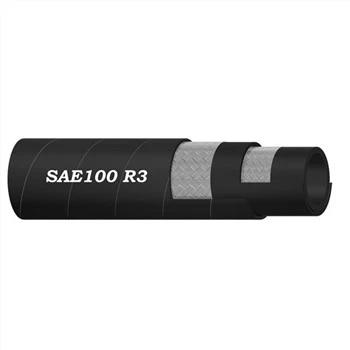
If you’re not sure which hose you need for your system, or you have questions about sizes, pressure ratings, or application-specific variants, our team is here to help. We supply SAE standard hydraulic hoses for all kinds of industries, and we can walk you through picking the right hose, getting a bulk order quote, and making sure you have the parts you need to keep your equipment running.
Thermoplastic Hydraulic Hose References
SAE International. (2020). SAE Standard J517: Hydraulic Hose Specifications. Society of Automotive Engineers.
Hydraulic Hose Association. (2022). Guide to SAE Hydraulic Hose Standards and Application Selection.
Maczuga, J. (2021). Hydraulic Hose Reinforcement Technologies: Braided vs. Spiraled Wire Designs. Industrial Hydraulics Magazine.
Construction Equipment Association. (2023). Hydraulic Hose Best Practices for Medium and Heavy Machinery.
Hebei Qianli Rubber Products Co., Ltd.
As one of the most professional sae standard hydraulic hose manufacturers and suppliers in China, we have world-leading production equipment and strong manufacturing capabilities. Please feel free to buy bulk durable sae standard hydraulic hose made in China here from our factory.
Address: West industrial Zone, Jing County, Hengshui City, Hebei Province, China.
E-mail: manager@hebeiqianli.com
WebSite: https://www.qianlirubber.com/
